


to be seen: Forgotten Australians Community Education Report and Priorities
18 December 2025
Please note: This article contains references to child abuse, neglect and abandonment that may be distressing for some readers.
On 12 November, over 60 Forgotten Australians and their supporters gathered at Open Place in Richmond to launch the Forgotten Australians Community Education Report and Priorities: to be seen.
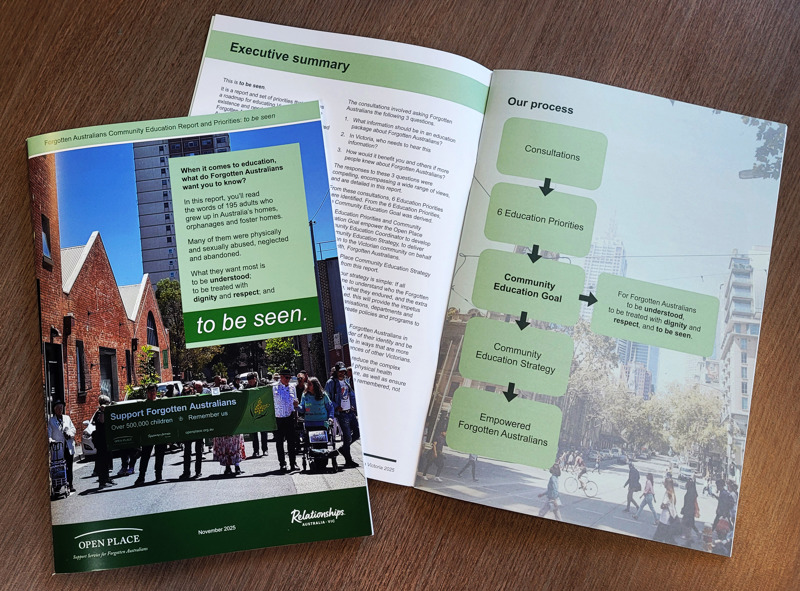
Open Place is a specialist service for Forgotten Australians in Victoria, operated by Relationships Australia Victoria and funded by the Victorian Government Department of Families, Fairness and Housing and the Australian Government Department of Social Services.
This report provides a roadmap for educating Victorians about the existence and needs of Forgotten Australians. It includes the words of 195 adults who grew up in Australia’s homes, orphanages and foster homes. Many of them were physically and sexually abused, neglected and abandoned. What they want most is to be understood; to be treated with dignity and respect; and to be seen.
The launch was a memorable and emotive occasion, attended by Forgotten Australians and representatives from Open Place, Relationships Australia Victoria, the Alliance for Forgotten Australians and several government and community organisations.
Attendees heard a musical performance by Forgotten Australian Alan Bowles, and speeches by Senior Manager, Open Place Michelle McDonald; Relationships Australia Victoria (RAV) CEO, Dr Andrew Bickerdike; Open Place Coordinator Community Education, Richard Dove; and guest speakers Dr Dave McDonald from the University of Melbourne, and Maree Holt from the Alliance for Forgotten Australians.
‘Despite the advocacy of so many, the Senate inquiries, State and National Apologies and redress schemes; the Forgotten Australian story remains largely unknown within the Australian community and within services and agencies that Forgotten Australians need to engage with,’ Michelle McDonald said, as she introduced the report to those gathered.
‘Forgotten Australians will never get their childhood back. However, through active community education on the part of all of us, their story can be told and understood, and they can be treated with dignity and respect.’
In her message of support, which was read out by Ms McDonald, Ms Sarah Witty MP who is the Federal Member for Melbourne said that she ‘is acutely aware of the suffering endured by the Forgotten Australians’ and ‘believes strongly that we must do more. It is not enough to acknowledge the past, we must ensure that the trauma experienced by Forgotten Australians is understood, accommodated, and never dismissed. Their voices must be heard, their needs respected, and their dignity upheld… [She] understands the importance of trauma-informed care and is committed to being a voice for Forgotten Australians, in Parliament, in policy, and in the community.’
Dr McDonald, Senior Lecturer in Criminology at the University of Melbourne, expressed his support for the report and spoke about its alignment with his Fellowship research into the lives and experiences of Forgotten Australians.
Ms Holt, a Forgotten Australian and Board Member for the Alliance for Forgotten Australians (AFA), accepted a copy of the report on behalf of AFA.
Richard Dove spoke about Open Place’s 2024 March for Forgotten Australians, the 2009 National Apology to Forgotten Australians, 20th century institutional ‘care’ in Australia and the experiences and hopes that Forgotten Australians have shared with him throughout the ‘to be seen’ consultation process.
Speech delivered by Open Place Community Education Coordinator, Richard Dove, at the launch of the ‘to be seen’ report on 12 November 2025.
On the day we marched, it was sunny. The words Forgotten Australians/More than 500,000 children/Remember Us stretched across the length of the banner on a background of Open Place green: our symbol hiding humbly in the corner. Six pairs of proud hands clasped the pole that ran along the top; faces proud and sombre lined above. Those in wheelchairs and walkers were placed in the first row behind (at the behest of Forgotten Australian, Sally Johnson, who rightly told me she was tired of watching marches where those in wheelchairs and walkers were left discarded like rubbish, straggling behind the pack) as about one hundred and fifty Forgotten Australians gathered from every corner of Victoria, and beyond, and made their way down Bromham Place in Richmond. A Victoria Police car, with blue and red lights ablaze, crawled along in front and five uniformed officers marched slowly behind, shoulder-to-shoulder, in solidarity with the slow-moving hoard. At Citizen’s Park (the march’s destination), the Open Place staff awaiting our arrival commented later that it felt like they were taking part in the final dramatic scene on a Hollywood movie set. It certainly did feel like something special was happening.
“Forgotten Australians? Who are they?” asked onlookers, as did many people throughout the course of the day. Who are they, indeed.
When the words of the National Apology to Forgotten Australians was read out during the memorial event by the Senior Manager of Open Place, Michelle McDonald (originally delivered by Prime Minister Kevin Rudd on 16 November 2009) all noise was sucked into a vacuum, as a howl – a gut-wrenching cry – escaped the mouth of one person, doubled over to the side of those seated. It was the unmistakeable moan of human suffering, emanating from the depths of a wounded soul. A child’s sorrow, long left to fester within; and on this day, released with the word ‘sorry’ – such is its power, when issued with sincerity.
“Sorry – that as children,” quoted Michelle, her voice quavering, “you were taken from your families and placed in institutions where so often you were abused. Sorry – for the physical suffering, the emotional starvation, and the cruel absence of love, tenderness and care. Sorry – for the tragedy of childhoods lost, of childhoods spent instead in austere and authoritarian places, where names were replaced with numbers, the joy of learning by the repetitive drudgery of menial work. Sorry – for all the injustices to you as children, who were placed in our care. As a nation, we must now reflect on those who did not receive proper care. We look back with shame that many of you were left hungry and alone with nowhere to hide and nobody whom to turn. We look back with shame that many of these little ones who were entrusted to institutions and foster homes – instead were abused physically, humiliated cruelly, and violated sexually….”
Of course, not all children who grew up in Australia’s institutional ‘care’ experienced the worst of these conditions, but according to the Long-term Outcomes of Forgotten Australian (LOFA) Study conducted by the University of NSW, most did: 60.3% experienced sexual abuse by an adult or peer; 87.3% emotional abuse; and 96.7% some form of maltreatment. As I stood and listened to these words uttered by our Prime Minister 15 years before, I was astounded that so many are still unaware. Unaware that up to, possibly more than, 500,000 children were subjected to this unabashed cruelty before 1990, and that they have a name: Forgotten Australians. How can we be so oblivious, when it is likely that so many pathologies experienced by Australians today can be attributed to the inherited trauma of childhood institutional brutality and abuse? Scratch the surface, delve into your family tree, you will likely find it – it is often hidden, buried deep in shame.
Of the 500,000 or so children that spent more than six months in institutional ‘care’ in Australia, around 50,000 are the Stolen Generation – you likely know of them well. Then there are the 10,000 child migrants from Britain: The Lost Innocents – the term ‘migrants’ could lead you to believe there was a choice. The remaining 440,000 are the multi-generational Australian-born: the Forgotten Australians. They are your grandparents, or great grandparents, or even your mother or father. Many have hidden it; even from their spouses.
Having recently spent months travelling around Victoria listening and capturing the words of Forgotten Australians, I ask myself, isn’t not knowing the real shame? Why were we not taught about Forgotten Australians in schools, universities - everywhere? Why are we still not? Why can’t a Forgotten Australian or a “care” leaver” walk into a doctor’s surgery, a dentist, a hospital, Centrelink, or any other service provider and be able to say, “I’m a Forgotten Australian,” and it be met with empathy. “Yes, I understand what that means. Please have a seat over here and I’ll let the practitioner know. Is there anything we can do to help make your visit with us better – more tolerable?”
If, for one minute, we could experience life inside the mind and body of a Forgotten Australian, perhaps then we would understand why it is so important for us to know who they are, what they’ve been through, and that it wasn’t their fault. Complex Post Traumatic Stress Disorder (C-PTSD) is difficult to explain, but the C-PTSD Foundation says, “… it is a long-term condition caused by childhood abuse and trauma. A survivor is someone who was exposed to traumatic events repeatedly for a prolonged time. S/he (keeps) the trauma locked inside the brain and muscles all over the body long after the abuse has stopped.” During the consultations I earlier stated, one Forgotten Australian explained it to me in the following way. “My skin may look normal. I may look normal. And I sit here and talk like normal. But inside me, it is a war.” Another said, “And to top it all off, I live as (though) I’ve walked through Hell’s Doors. For the rest of my life. But I have art and that’s a positive for me.” And another wrote, “Something in my childhood tears me apart deep inside me. I HATE GETTING UPSET. … …. Boys Home ruin(ed) me and OTHERS. I need (to) find myself. Someday I will.”
For most Forgotten Australians, asking for help can feel difficult and degrading, and talking about childhood is often a trigger. How can you explain to somebody you’ve never met that you’ve been sexually and emotionally abused repeatedly by those who were supposed to care for you; beaten and locked under the stairs or in a cupboard when you misbehaved; paraded naked in front of other children when you wet the bed; forced to work when you were eight years old; experimented on by the health industry; turned out into the world without a family or education at 16 years old; locked up at 18 and abused again. And that your body and mind lives as though it is still happening? How can this be explained when you’re standing at the queue in the emergency department at the hospital and you’re having a full-blown panic attack, and it’s the third attempt to see someone without breaking down or running out the door. How?
Imagine how much better it would be if people just knew. If Forgotten Australians were treated like somebody instead of just another difficult person, or even worse, a criminal – as some attest. Imagine if services took just a little bit of time to make things better for that person, just by saying, “I understand what it means to be a Forgotten Australian,” and meaning it. This is the inconceivably enormous task before us. There has been a Senate Inquiry, a Royal Commission, a National Redress Scheme, a National Apology, State Apologies, memorials have been erected, and personal apologies given by many institutions, and more, but Forgotten Australians are sadly, ashamedly, still forgotten. Not known. Invisible. Suffering.
“They say sorry, but they don’t mean it,” were words I heard often during the consultations. “Sorry is just a word,” said others. “Words are not enough,” said some. When the nation apologised to Forgotten Australians 16 years ago, there was so much hope. Forgotten Australians had been told so many times, as children, and as adults, that the abuse they endured was not true. Finally, ‘they’ had listened, and acknowledged the truth of it, and the pain of those who had suffered – who still suffer. It was a time of healing, relief, and expectations of a more positive future. People would finally know what happened – and they do. They do know what happened. Sexual abuse in institutional care for children has been a regular feature on the front of the newspaper for many years. There are books written about it, movies produced, plays scripted. Ask anybody, “Were there children in institutional care in Australia who were abused throughout the twentieth century?”
“Yes, of course.”
“What name do they give the survivors?
“Umm…. ”
There has been some restitution by way of a National Redress Scheme, and the Victorian State Government have grappled with another. All states and territories now have offered an apology. Some institutions have acknowledged and accepted responsibility, while others have taken a more cynical approach. A few brave Forgotten Australians have had some success through lawyers (which can take many years), while most cannot face either redress or the courts; the pain is just too difficult. But when I ask them what they want – what they really want the world to know – the answers are quite simple. They want people to know who the Forgotten Australians are; and to understand that life after a highly traumatic childhood is extremely difficult. They want to be treated with dignity and respect, just like everybody else, and to not be judged for what was not their fault. They want to be able to walk into a hospital, an aged care facility, a dentist, Centrelink, anywhere, and be able to say, “I’m a Forgotten Australian,” or “I spent time in institutional ‘care’ as a child” and the person on the opposite side of the counter will know what that means, and how difficult it is to seek help. They want redress, and the apologies, and all the things that have, to date, been provided by the governments and institutions. More than anything, they want the things that happened to them to not happen to the next generation. However, some of the things they have craved have always been out of their reach. It has eluded them, and they are at odds to explain why. They want their past to be acknowledged; and for all Australians to know what happened to them, no matter how difficult it may be for you to hear. They don’t want to be ‘Forgotten’; they want to be remembered. They want to be seen.
On the day we marched, it was sunny.
Across 4 months in late 2024 and early 2025, the Open Place Coordinator Community Education consulted 195 Forgotten Australians across rural and regional Victoria, and in metropolitan Melbourne.
The consultations involved asking Forgotten Australians the following 3 questions.
- What information should be in an education package about Forgotten Australians?
- In Victoria, who needs to hear this information?
- How would it benefit you and others if more people knew about Forgotten Australians?
From these consultations, 6 Education Priorities were identified:
- How can you still not know who we are?
Forgotten Australians want for all Australians to know the history of Forgotten Australians; for their traumas to be understood; and for Forgotten Australians to be treated with dignity, respect and understanding. - The tick-box
Forgotten Australians want a process to be able to identify as a Forgotten Australian at all services in Victoria, and to have this met with understanding and empathy. - The forgotten forgotten
Forgotten Australians want all Forgotten Australians to know they can identify as a Forgotten Australian; and to be informed of the support available to them. - Healthy health services
Forgotten Australians want all health, mental health, dental, aged care and palliative care services in Australia to be compassionate and empathetic towards Forgotten Australians, and to develop practices to reduce and prevent re-traumatisation when accessing these services. - Education! Education! Education!
Forgotten Australians want the history, apologies, abuses and inquiries relating to Australia’s institutional care system for children to be included in primary, secondary, and tertiary education curricula in Australia. - We are family
Forgotten Australians want programs and projects to help them build a sense of belonging and identity within the Forgotten Australian community, within the wider community, and within themselves.
‘I commend this report and acknowledge the courage and resilience of the 195 Forgotten Australians who contributed, and of all Forgotten Australians,’ Dr Bickerdike said in his address.
‘Open Place and Relationships Australia Victoria are committed to achieving the 6 priorities of “to be seen”, enabling Forgotten Australians to participate in life in ways that are equitable to other Victorians, and reducing the complex psychological, social, and physical health issues many presently endure. It’s important that we ensure the mistakes of the past are remembered, [and] not forgotten, or repeated.’
We encourage you to read the report and share it with your colleagues, networks and communities.
To request printed copies of the report or a free community education presentation at your organisation, service or community group, please email [email protected] or call (03) 9421 6162 and ask to speak to the Coordinator Community Education.